Most fantasy cities are a map with shops on it. The party arrives, buys rope, sells a sword, and by the third session the place has stopped asking anything of them. The fix is cheaper than another district, and it starts with a list of what things cost.
You know how it goes. You spent a weekend on the city. There is a harbour, a temple quarter, a thieves' guild with a good name. Then the party walks in, and every question they ask has the same answer: which street, and how much gold. By level five they have enough gold that the second half of that answer has stopped mattering.
So the city goes flat. The districts are still on your map, and your players still can't tell them apart, because in play they all do the same thing. They sell things to people who can afford them.
Why a map can't do this job
A map tells players where things are. It has nothing to say about what they are allowed to want, or what wanting it will cost them, and that is where a city gets its character. Think about any real place you have lived. You don't remember it by its street grid. You remember who you had to know, what you couldn't get after nine, and which neighbourhood would charge you double for looking lost.
The default fantasy economy works against all of that. Gold is one coin at one rate, good in every street and forgotten the moment it changes hands. Every transaction closes. Nothing is owed afterwards, so nothing that happens at a market stall can come back in session twelve.
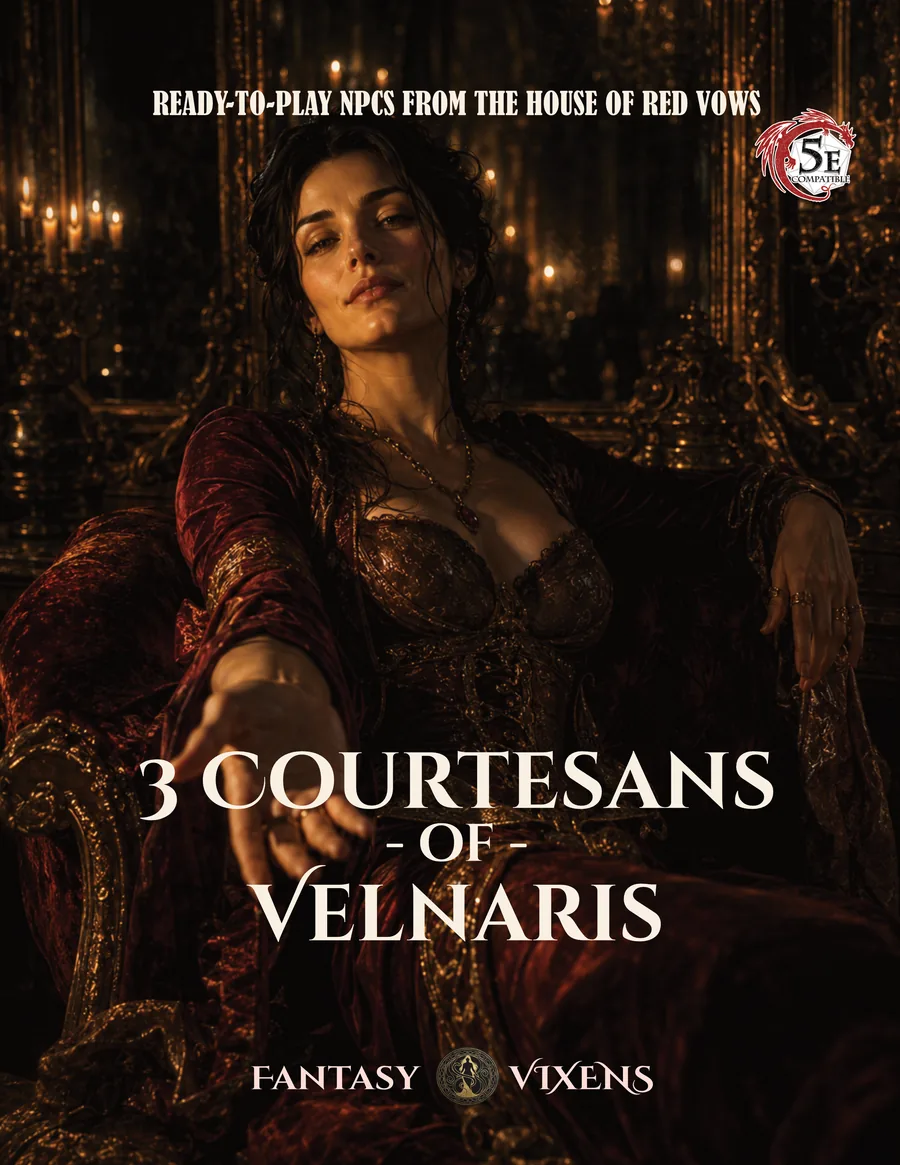
A city starts to feel alive when buying something leaves a mark. That idea is the foundation of Velnaris, a gothic port of about fifty thousand people, run on paper by a Merchant Council and in practice by whoever holds the second ledger. I'll use it for every example below, and the method works just as well on a city you already have.
Four entries for a better price list
1. Decide what each district counts
Forget "the merchant quarter". Ask what a district counts, and who does the counting. Velnaris has thirteen districts above ground, each with its own law and its own currency, and the currency is rarely money.
In the Crossings, the commodity is honesty. Gold isn't trusted until the weighmasters of the Brass Scale have assayed it, and the locals have a line for that: unstamped gold is just heavy metal with an opinion.
In Spite, the lowest ground in the city, the unit is debt. The local syndicate keeps a master book called the Grey Ledger, and it records what you owe, not what you stole. A thief can live with that arrangement for years before noticing what it means.
At Corvin Yard, the garrison quarter, the thing counted is bodies. There is a dusk roll and a dawn roll, and the gap between them is the most-watched number in the city.
So you get three questions per district. What is counted here? Who counts it? What does it cost to be left uncounted? The third question is your adventure. Corvin Yard's answer has a name: a corrupt limb of the Watch called the Ninth Bell sells the hour nobody counts. No street name was ever going to hand you that.
2. Keep two books
Every institution in your city should have a record it shows and a record it keeps. Velnaris has the slang ready: the second ledger is the real book, and the first one is for the Council.
Try it on one faction before your next session. Write one line for the official version, one line for the true version, and the name of whoever can open the second book. A shipping house's first ledger says it imports grain. Its second says who gets paid when a cargo goes missing.
Now your players have something to want that isn't gold, and the city has something to protect. Every heist, audit and blackmail in the campaign grows in the space between those two books.
3. Leave some rows blank
If I had to throw out everything else here, I would keep this one. A good price list has rows without numbers.
The price table in the Player's Guide to Velnaris lists a guild seal on an honest document at 2 gold. The next row is a guild seal on a document that should not have one, and its price reads: ask, carefully, in the Crossings lanes. Further down, a witness's silence is negotiated, never cheap.
A number closes a conversation. A blank opens one, because the only way to fill it in is to find someone and talk to them. Every blank row is a scene you have already promised your players, and the only prep it asks of you is the person at the other end.
Then give a memory to the rows that do have numbers. A Watch patrol that finds somewhere else to be for an hour runs 15 gold, and the entry finishes: and they remember. Three words, and a bribe becomes a relationship.
Information gets the same treatment. Velnaris prices secrets by weight, which means what someone will do to keep it unsaid, whatever it happens to say. A dull fact about a dangerous person can outweigh a scandal about a harmless one.
One multiplier does the rest. Anything on the list roughly doubles when you need it done with no name attached, because the person on the other side is taking the risk instead of you. That gives your players a decision they will keep having to make: how much is their name worth tonight?
4. Make favours a currency
The most expensive line on the list costs no gold at all. A discreet introduction through the House of Red Vows, the city's great courtesan house, costs one favour owed. The street's own definition of a favour is the best one I know: often better currency than coin, and much harder to put down.
Gold leaves the sheet when it is spent. A favour stays, and it belongs to someone else. So make it physical. One index card per favour: who is owed, what it bought, and an empty line for the night it gets called. Keep the cards face up on the table, where the whole group can see them through every other scene.
Two rules for running them. Call a favour at the worst moment you can justify. And let the character refuse, because a refusal is a story too: the creditor tells someone, and a door somewhere in the city quietly closes.
One errand, priced out
Put the four together. Say a friend of the party has deserted from Corvin Yard, and they want the name off the muster roll before the dawn count.
They need paper, so they go asking in the Crossings lanes for a seal that shouldn't exist. There is no number to haggle over, only a notary who would like to know why. They need the hour nobody counts, so someone has to reach the Ninth Bell, and the one person who can make that introduction sits behind a red lamp in Vesperine and would like one favour, to be named later. And they want all of it done without a name attached, so everything doubles.
Now look at what they have spent. The gold is the least of it. A forger knows what they needed forged. The Ninth Bell remembers who bought the hour. And an index card is lying on your table, face up, waiting.
The city has also asked them something, which is how far they will go for a friend and what they will be to themselves afterwards. That question runs under the whole setting: What will you become when you get what you want? It is hard to ask over a bag of gold. A debt asks it every time someone looks at the card.
Running it at your table
Start with one district. Answer the three questions, give one faction its two books, and write a price list of ten rows, with three left blank and one that remembers. Hand it to your players as a sheet of paper at the start of the session. Then say nothing about it, and wait for someone to ask about the blank row.
Keep your map, by the way. It tells them where to walk. Velnaris has one too.
Where this comes from
Doing this for one district takes an evening. Doing it for thirteen, so that every quarter prices something different and the prices still agree with one another, took considerably longer.
If you would like to see it finished, or hand it straight to your players, the Player's Guide to Velnaris is free. Its 37 pages hold the price table quoted above, the thirteen districts in a line each, the city's slang, d10 rumours and d8 downtime, along with four peoples with full 5e (2024) traits and a Session Zero safety chapter. It is 18+, intimacy fades to black by default, and nothing in it comes from the GM's side of the screen.
Player's Guide to Velnaris is free on the store.
Next in this series: how to build a safe place that bites back.
Tags: Tabletop RPG · Game Master Tips · Worldbuilding · Dark Fantasy · Velnaris
Lorenza Nevada is the writer and designer behind Fantasy Vixens, a dark fantasy TTRPG imprint. Her books are on DriveThruRPG, and several of them are free.